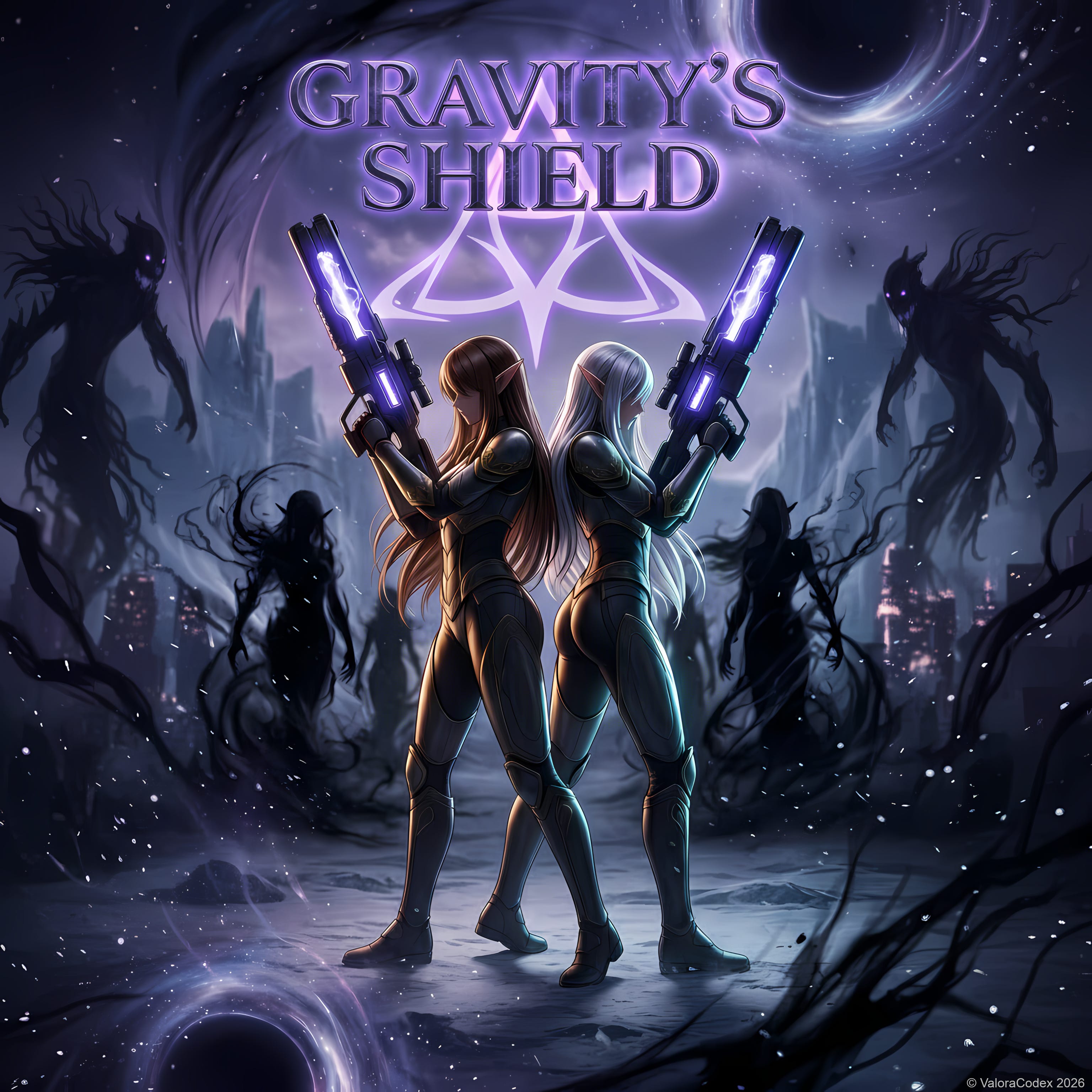
Gravity’s Shield: Chapter 1-4
This story is also published on RoyalRoad and X @ValoraCodex.
Synopsis:
No one knows why the Lysianvael (World-Chord) decided to propagate itself into a newly discovered dimension. Its 3.7 Hz hum is one of the few mechanisms keeping a desolate, frozen, gravity-warped tundra frontier from collapsing into an entropic vacuum. When the Civic Government sends two Vanguard scouts, Evel’Lara and Vael-Shyr, to begin seeding the beginnings of a military base, they must operate at the edge of the Valoran Defense Force’s help and reach. Tasked with daily, almost-ritualistic, and mundane chores of record-keeping and maintaining their tech, they monitor and maintain a fragile atmospheric bridgehead in the newly accessible dimension. Survival demands absolute precision—calibrating thermal sensors, cultivating greenhouse lilies, and anchoring their sanity to the domestic rituals of tea against the crushing psychological dissonance of interstellar/interdimensional isolation. As the outpost expands to process an influx of colonists from their all-female society, the carefully managed equilibrium shatters. The primary threat to the settlement is not the risk of hypothermia, ionizing radiation outside the shields, or even the localized dimensional instability manifesting inside the base, but something far more abstract and ancient. To secure the survival of both their base and their realm, the scouts must transition from environmental wardens into frontline defenders/vigilantes against a newly cosmic metaphysical entity before it systematically consumes their tether to the local gravitational fields and home.
Gravity’s Shield
Chapter 1: Tea at the End of the World
The 3.7 Hz hum of the atmospheric shields vibrated through Evel’Lara’s small feet—a reminder of the super-chilled air that pressed and scraped against every wall, corner, and seam.
Too cold to bear.
She turned her stiff neck to check the digital display she had set on the table.
Two months. That’s how long she had been here. Two months at Grýth’Sīl-Vire (The Gravity-Shield Node).
She couldn’t feel much of anything at this point, so she reached under her shirt and made sure her issued nipple guards were still adhered to her skin. Chafing in this environment would only add to her numbed suffering.
She missed home and its mild-mannered forests. At least there she could wear her cutest clothes.
If she ever dared to wear anything thin here, the cold would find its way in, seeping under her skin and finding her knees and ankles first, stiffening them, then dulling thought and senses alike.
She shivered just thinking about it, then sighed—time to work.
Outside, the sky was the bruised purple of a localized gravity collapse, ionizing radiation meeting magnetic-fields, and a hint of Chicory Root Pie. Inside, the only pressing disaster was the whistling kettle. She poured water over dried Seryn-kaia leaves, letting the sharp, woody steam fog her visor.
The hiss of the blastdoor greeted her when she returned inside.
Across the room, Vael-Shyr was asleep, her cheek pressed against the casing of a dismantled plasma rifle. To her voueyer’s surprise, she looked... almost angelic. The would-be-lurker, Evel’Lara, draped a heavy thermal blanket over Vael-Shyr’s shoulders, careful not to wake her. The world could end tomorrow; right now, the tea was getting cold. Even indoors, the cold was an ever-present predator, prowling for exposed skin. She shivered.
Evel’Lara picked up a small, notched gear from the table, focusing on the linear precision of its teeth—a necessary act of aesthetic dampening to ground her spirit against the growing dissonance of the storm outside. Vael-Shyr stirred, her fingers twitching as if she were still navigating the complex resonance of her mech’s internal systems.
“Tea’s up,” Evel’Lara murmured, her voice steady and resonant, tuned to the safety of the room’s baseline frequency.
Vael-Shyr sat up, the russet fur of her ears flicking toward the sound. “Is the shield holding?”
“It’s nominal—phenomenal—completely astronomical,” Evel’Lara replied, sliding a ceramic mug across the workbench. “The Salt-Cross frequency hasn’t shifted a fraction. We won’t be doomed tonight.”
Vael-Shyr frowned at Evel’Lara’s word choice. She then wrapped her hands around the mug, the heat from the liquid equalizing the cold debt she had carried since her last patrol on the perimeter. The automated sentries patrolled with her, but they couldn’t feel the cold. They sat in a shared, comfortable silence, the quiet clinking of the mugs the only sound against the backdrop of the cosmic weather.
Vael-Shyr wondered what would happen if one of their mugs broke—it would take weeks for a replacement to be delivered by Valenydria. The orbital strikes were merely distant flashes reflected in the dark surface of their tea. Time-Zone 24E’s gift to their home dimension of Valora, the now distant world they called home.
“We need to calibrate the sensors on the greenhouse tomorrow,” Vael-Shyr said, her voice trailing off into a yawn. “If the heaters fail, the lilies won’t make it through the night. And without lillies, our humble dwelling will look less like a home for the next six-months and more like a shanty hole-in-the-wall.”
Evel’Lara nodded, her thumb tracing the smooth, cool edge of her own mug. “Tomorrow. For now, just drink.”
The “World-Chord” continued its steady, 3.7 Hz thrum beneath them, a silent promise of endurance in a universe that felt like a falling archway. Inside the workshop, the warmth was enough. The Lysianvael, known more simply as the World-Chord, was not only a natural phenomenon but also the ancient frequency said to bind their world and keep invasive realities at bay; if it ever faltered, the entire region could collapse into a chaotic vacuum. The World-Chord was like an invisible net stretched beneath the skin of reality, catching stray fragments of unmaking before they could devour the land. When it vibrated true, stones remained solid and days bled smoothly into the next. If it ever went silent, legends said, you might watch your own shadow peel away as the vacuum consumes you—somehow the foreign laws of physics tried to rewrite the ground beneath your feet. Somehow, the World-Chord had propagated to this dimension—no one understood how or why—and the Civic Government had assigned her and Evel’Lara, two high-ranking scouts of the Valoran Defense Force led by Grand Matriarch Draconia, to establish a scouting base. Their mission: watch for any disruptions or anomalies in the World-Chord and report meaningful changes. Failure could mean disaster not just for their outpost, but for the fragile barrier separating their home from the void.
“Do you think anything will happen today?”
“You mean if there’s one more cloud than the day before? I don’t think so.”
“I didn’t mean that.”
“I know,” Evel’Lara frowned and thought for a moment, “Honestly, maybe, I noticed seismic activity northwest of here.”
“Magnitude?”
“5.4”
“Only 5.4?...”
Evel’Lara frowned harder, “Be happy we are getting more elves to visit us tomorrow! I am sick and tired of interacting with AI and Patrol Bots.”
“Why? They’re not so bad.”
Evel’Lara scoffed at Vael-Shyr, “You have always been an unusual elf; you may not need more social contact, but I do.”
“Whatever,” Vael-Shyr laughed, batting her eyes, “They don’t judge as elves do.”
Evel’Lara nodded, “Yes, they would rather nod and agree with you than actually critically think.”
“Not exactly!...” Vael-Shyr began, “There’s always the—”
—before she could finish her sentence, a faint alarm, one of the many dozens in their little fort-away-from-home, rang.
“What alarm is that?” Vael-Shyr asked.
Evel’Lara walked over to the command console and checked. The console’s blue screen gave her face more definition than normal lighting.
“Proximity alarm.”
“Proximity?”
“Yes, a localized proximity alarm about 3000 meters from the command console.”
“You mean...”
“Yes, it’s coming from... inside the base.”
Chapter 2
A Bump In The Night
“What do you mean the alarm is coming from inside?”
“I mean exactly that, there is an alarm coming from inside.”
Vael-Shyr rolled her eyes at Eval’Lara, “How ever did you make it past the scout academy?”
Before Evel’Lara could reply, Vael-Shyr had already entered the code in her keypad to the container module to her left.
Eval’Lara watched as she pulled out a plasma rifle, a standard-issue Vesh-Arc-99 with pulsed-Q-switching. The 99-centimeter-long rifle weighed a dense 6 kilograms—a heavy-pattern frame that would have exhausted a human scout, but felt like a balanced feather in Vael-Shyr’s high-density elven grip. Its chassis was finished in a matte-black Carbon-Boron Lattice, interwoven with the faint, glowing silver filaments of the Tir-Null Guard. Though sleek, the weapon possessed the massive inertia and fracture-toughness to cave in a reinforced bulkhead; with Vael-Shyr’s strength behind it, the buttstock wasn’t just a handle—it was a thirteen-pound sledgehammer designed to shatter the Vael-Rheo hide of a monster.
Even at 1.74 meters and 58.3 kilograms, Vael-Shyr looked extremely formidable. Eval’Lara was nearly the same height and build, but Vael-Shyr was an excellent soldier before being recruited as a scout for the VDF. Eval’Lara had instead spent her time and Essendra on more cognitive magic and abilities.
“Shoot first and ask questions later?” Eval’Lara asked.
“No. We are elves, not humans. We are a welcoming committee.”
“So why the Vesh-Arc?”
“I heard in Sapphirehold, they have begun the tradition of hitting a container filled with candy at parties.”
“Really? That’s a new one… so that is for?...”
“The party, of course.” Vael-Shyr said, “Monitor the cameras and keep an eye on the perimeter while I scout the bunker?”
“Vye, Vye,” Evel’Lara nodded as she walked over to her command console and began typing something in the controls, “Patrol bots are en route. We’ll have eyes on the area in a few moments. I will patch it through to your comms.”
Vael-Shyr nodded as she placed her helmet on her head; the polarized visor equipped with active night-vision made it impossible to see her eyes.
Bulkhead
The door hissed as it closed. Another blastdoor, one of the many hundreds found throughout the base, to ensure direct cutoffs if zones became compromised.
The magnetic seals of Vael-Shyr’s rig exhaled a pressurized hiss as the Vesh-Arc-99 integrated with her tactile array, a virtualized HUD appeared on the top left of her visor—her vitals appeared shortly later in the top-right.
Before Vael-Shyr could comment, Evel’Lara beat her to it, “Phenomenal vitals,” she heard her scouting partner say confidently into the comms.
“You can keep the lights off,” Vael-Shyr said over the comms as she continued walking down the dark corridor.
“You’re not afraid of the dark?” Evel’Lara asked.
“Only when I’m in the same room as you,” Vael-Shyr confirmed. “There’s no point in wasting energy when these visors have night vision and a polarized lens.”
“Spoken like a true bot,” Eval’Lara said. “Scouting drones and patrol bots have rounded the corner, 2000 meters from the source. I’ll patch their feed to your vision now.”
A moment later, Vael-Shyr had access to a grid of eight camera angles. Direct visual data from the floating drones and the patrol bots. They were all named something generic in their upper-left visual panel.
BOT-1 led the group, followed by BOT-2, BOT-3, and BOT-4; DRONE-3 and DRONE-4 followed behind them–DRONE-1 and 2 guarded the BOT’s flank. They briskly pedaled towards the destination. Vael-Shyr was 2800 meters away.
Vael-Shyr did not worry. Even if her visor failed, elves still had natural night-vision, but the Valoran Defense Force liked to remain technologically superior to the Celestial Elves.
A faint tremor, then a slight rumble, occurred around Vael-Shyr.
“Magnetic storm. Outside,” Evel’Lara beat her to it again.
Vael-Shyr continued in the dark of the hallways and corridors—as she did, she wondered about how, in the next few weeks, the base would be more lively—and if she even wanted that. Evel’Lara liked having company, but Vael-Shyr had gotten used to having just her partner around—and the maintenance bots.
“Got can update from Valenydria,” her partner said over her comms.
“And?” Vael-Shyr asked.
“Transport and first crew are set to portal into our dimension within the next 48-hours.”
“Excellent,” Vael-Shyr said.
Only silenced returned.
“Evel?” Vael-Shyr asked aloud.
“Sorry,” Evel’Lara said, “You didn’t sound too happy to hear that.”
“I just have a hard time getting people to like me,” Vael-Shyr said.
“What’s there not to like?”
“Funny,” Vael-Shyr replied.
“What?”
“I’m not like you, Evel. I spent most of my life navigating dark tunnels in Zephyria and tinkering away on service bots and dropships.”
“Right. But they are your teammates. They’ve been through similar training as us.”
“That’s even worse.”
“How so?”
“Because if we’ve all been trained the same and I still show them how different I am, then the only explanation left is that I’m just not a normal elf.”
“Vael…”
The HUD went red.
“Another proximity alarm. 5000 meters from the command console.”
“How?!” Vael-Shyr asked, surprised.
“Don’t know. Perimeter shields, sensors, and radar are still one-hundred percent phenomenal… Let me run and check some diagnostics for any potential environmental anomalies.”
“Mør?”
“Couldn’t be…” Evel’Lara said, “Void Rifts are unable to self-propagate here in 24E.”
“Stowaways?”
“Who in the Diel would want to come here?”
“You’re right.”
Vael-Shyr checked her vision—she was now 2000 meters from the first breach. She checked the bots on her HUD. They were still waddling towards the breach.
“Will you be okay?” Evel’Lara asked over the comms.
“Why? Is something heading my way?” Vael-Shyr asked.
“No. I am just asking because I’m worried about how you may be feeling.”
“Oh.” “Yes, I will be fine.”
The way she said it, Evel’Lara believed her.
Perimeter caught something flying near us; the automatic turrets sent an ultrasonic ping and confirmed it was biological, with no shielding or armor. The turrets opened fire automatically. Evel’Lara watched on her command console as the cameras from Turret-5 and Turret-6 opened fire at something unseeable in the distance.
“Outer perimeter caught another flier. Turrets chased it away.”
“Shooting at birds again?”
“Not a bird—at least—not a normal bird. It absorbs most of our soundwaves and radar whenever we try to probe its telemetry.”
“Contact!”
Vael-Shyr’s HUD showed the camera on BOT-4 went dark.
“BOT-4?” Vael-Shyr asked aloud. Something would have had to pass the group of bots to take out BOT-4.
“I reviewed the footage and data, and nothing got past the other BOTs and DRONEs,” Evel’Lara said.
“The only thing that could have done that would be Mør or a Shadow Elf.”
“There can be no Mør in this realm. And the facility’s sensors have not picked up any biological—”
Although she was 1500 meters away, Evel’Lara heard it first. The acoustic sensors in the corridors caught faint echoes and vibrations—then it grew more intense—
—Vael-Shyr heard it now. It sounded like keratin on metal—scattering—quickly.
“Vael, something coming down the corridor. Fast.”
“On it,” Vael-Shyr said as she got down on one knee and into a kneeling, unsupported position. Her rifle’s scope flickered on. Infrared.
The crawling got louder.
Tat. Tat. Tat.
Vael-Shyr focused.
Tat. Tat. Tat.
“930 meters from you now, Vael.”
A hungry crawl.
Tat. Tat. Tat.
Vael-Shyr gripped her rifle. She was ready. Her vitals stayed the same.
“748.”
Scraping.
Tat. Tat. Tat.
“419—gaining speed. One meter-per-second.”
Tat. Tat. Tat.
Dense thudding on metal.
Vael-Shyr gripped harder. She exhaled. Her vitals stayed plateaued.
“320. 217. 115.”
Tat! Tat! Tat!
She aimed.
The echo had grown to its loudest. It was a desperate hunger.
“It is right on top of you. Shoot it.”
Nothing.
Evel’Lara’s heart felt like it was about to beat out of her chest. “Vael?”
Nothing. Silence.
“Vael? Why are you okay??”
Still. Nothing.
Evel’Lara typed a command into her console and gained emergency access to Vael-Shyr’s visor and HUD.
Nothing.
Nothing was there.
“There’s nothing here?” Vael-Shyr said.
“What do you mean, there’s nothing there. We have the data, and we both heard it,” Evel’Lara stared at the large screen in front of her—Vael-Shyr’s point-of-view—she was still kneeling unsupported, her arms and hands still supporting the Arc-99. The infrared scope was dark except for the dimmed lunakyr crystals that were evenly placed on the floor and ceiling, just in case non-elven species had to work at the research station.
“There is nothing here, and the scattering stopped.”
“Impossible.”
“You’re seeing what I’m seeing, right? It’s definitely possible.” Vael-Shyr sighed as she got up. Her blood pressure spiked slightly as she stood quickly. For a brief moment, she felt light-headed, but the feeling quickly went away.
Chapter 3: Safety First
Vael-Shyr found BOT-4 two hundred meters farther down the corridor, powered down in the exact geometric center of the deck plating. Its diagnostic crystals were dark. The unit’s tracked chassis rested at a perfect forty-five-degree angle to the bulkhead seams, as if it had simply decided compliance was no longer required. She registered the geometry with the same clinical detachment she applied to every variable in 24E: precise, measurable, and therefore solvable.
“They don’t turn off,” Evel’Lara transmitted, voice tight with the precise frustration of someone watching her command net fracture.
“This one did.” Vael-Shyr knelt, the Carbon-Boron plates of her rig creaking softly against the cold. She pressed her wrist device to the bot’s access port. The connection synced instantly—no handshake lag, no error codes. Her thumb found the recessed power stud. Diagnostic crystals flared back to life in sequence: amber, cyan, then steady white. The machine whirred, recalibrated its inertial frame, and resumed its waddle toward the primary proximity alarm as though the interruption had never registered.
In Zephyria’s service tunnels, she had rebuilt hundreds like it from scrap after resonance-grid quakes. Machines did not possess will. They possessed states. When a state changed without an external cause, the fault lay either in the environment or in the observer’s model of reality. She preferred the former. The latter invited Ghor’yan—corrosive mnemonic heat that the World-Chord could not afford. Heidegger’s tool-analysis flashed unbidden through her training overlay: bots existed ready-to-hand, transparent extensions of her own high-density frame, until breakdown forced them present-at-hand—mere objects demanding contemplation. BOT -4’s unexplained shutdown had just performed that exact ontological fracture. She filed the parallel under “operational philosophy—verify later.”
Her footfalls remained silent—a practiced economy of movement drilled into her since her days navigating the tight, echoing tunnels of Zephyria. But the silence now felt like a vacuum, an absence where data should be. She mentally cycled through the schematics of the internal alarms, the complex logic matrices of the base’s sensory network. A 1200 Kelvin signature shouldn’t just leave no heat trace—it should begin to melt parts of the installation—it should raise temperature alarms and temperature suppression systems—but it didn’t. The acoustic scattering that mimics four separate vectors… then the patrol bot, designed by her own daily maintenance on the bot, that simply decides to turn off.
Every variable was a contradiction. In her experience, every flicker of a bot’s diagnostic crystal, every whine of a dropship’s failing reactor, had a clear, mechanical answer. The base was a machine, and machines followed rules. This anomaly defied them all. It wasn’t a magnetic storm or a structural failure—those were physics problems she could solve. This felt like a glitch in the very fabric of 24E, a silent laugh from the chaotic vacuum that the World-Chord was supposed to keep at bay. She tightened her grip on the Vesh-Arc-99. She wasn’t an academic like Evel’Lara; Vael-Shyr was a solution-finder. And if the logic of the anomaly remained elusive, she would impose a simpler logic: hot plasma.
“Main bot force has reached the lily-lab blast door,” Evel’Lara reported. “The 1200 K signature is still pulsing every four seconds. Flux remains localized.”
Vael-Shyr accelerated to catch the group. BOT-4 matched her pace exactly, its tread pattern syncing to her footfalls with obedient precision. She found the sight almost functional—a logical error. Endearment required projected consciousness. These units were extensions of her own maintenance protocols, nothing more. Yet she had spent two months alone with Evel’Lara and the maintenance swarm. In that isolation, pattern recognition had begun treating their predictable behaviors as companionship. Dangerous slippage. The Civic Government assigned scouts in pairs for exactly this reason: to prevent single operators from anthropomorphizing tools.
She paused at the next junction, fingers tracing the bot’s diagnostic seams with the same precise pressure her mothers once used on resonance-grid servos in the desert heat. One failed servo there had cascaded into full collapse; here, the same principle held. Optimal maintenance extended operational life, which extended their survival window. That was not sentiment. That was entropy minimization. Frakas the imp had taught her the difference as a child—his invisibility “ghost” tricks fooled the others until she measured the exact height vector. Unknowns resolved when you measured the right parameter. This one would too.
“Vael-Shyr, your heart rate is elevated,” Evel’Lara noted. “Problem?”
“My heart rate is fine.”
“Ten beats per minute higher on your personal bio-sensor. That qualifies as ‘not fine’ in my matrix.”
Vael-Shyr checked her own HUD. Evel’Lara was correct. The number sat there in crisp red—78 BPM against her normal resting 68. She forced a slow exhale. No stress response. She had proven that years ago in live-fire drills. When plasma filled the air, and claws scraped metal, her vitals plateaued. Killing did not elevate her. Uncertainty did. Her Genesis Bloom frame—high-efficiency DNA ligases knitting cellular damage faster than most insults could inflict it—registered the discrepancy not as cellular threat but as data fracture. Two measurement systems reporting mutually exclusive truths about the same body. The personal bio-sensor spiked while corridor arrays (RF disturbance, NIR-rPPG, thermal/acoustic micro-vibration) read baseline. She pressed her gloved palm into the specimen port; the panel chimed acceptance with a matching baseline. Then the numbers flipped. Now her HUD read normal, and the environmental sensor spiked. She felt the elevated pulse like phantom pressure behind her sternum—substrate warning, not claws.
“Stress response?” Evel’Lara pressed.
“No. I don’t get stressed when I think about killing things.”
Silence stretched across the comms. Evel’Lara knew her partner’s history. The same elf who had once removed her helmet in raw 24E atmosphere after losing a sampling kit, using her own liver and kidneys as a biological filter because dialysis was faster than waiting for resupply. “The air does irreversible damage at roughly forty-five hours,” she had stated clinically. “My systems clear it in two. Thirty minutes to the airlock. Logical.” That event had been logged as both brilliant and insane.
“Well… you’re reading normal on my end now,” Evel’Lara said. “Maybe false alarm.”
“It is still ten BPM higher on my end.”
“It’s normal here.”
“Check my HUD feed.”
Evel’Lara’s tone sharpened with diagnostic focus. “Your direct bio-sensor shows elevation. Corridor environmental array—RF disturbance, NIR-rPPG, thermal/acoustic micro-vibration analysis—all read baseline. Placing your hand against the specimen port now.”
Vael-Shyr pressed her gloved palm into the wall sensor. The panel chimed in acceptance. Readings matched the corridor array: normal.
Then the numbers flipped.
“Now my HUD is normal,” Vael-Shyr reported, “and the specimen sensor shows the elevation.”
“How do you feel?”
“Like I have an elevated heart rate. But the sensation just… stopped.”
Evel’Lara was quiet longer this time. “That’s… not within parameters. We’ll run full-spectrum diagnostics when you return. Are you cleared to continue?”
“I’m fine.” Vael-Shyr verified her oxygen monitor. Nominal. The discrepancy felt like a mirror held to her own code. She filed the anomaly under “investigate post-mission”. She pressed forward, inner ear registering the faint 3.7 Hz thrum of the World-Chord with a 0.00148 Hz micro-detune—barely measurable, yet enough to remind her the Chord was listening.
The bot force had assumed firing positions at the lily-lab blast door. Their plasma emitters hummed at standby. Vael-Shyr scanned the door. Visor overlay returned –40 °C. She removed a glove and pressed the back of her hand to the metal. The cold bit through her skin like liquid nitrogen. No thermal bloom. No distortion.
“Shouldn’t this be melting?” she asked.
“Forty minutes at sustained 1200 K and the lattice would begin slagging,” Evel’Lara confirmed. “The signature is still pulsing on my end.”
Vael-Shyr’s mind raced through failure modes. A 1200 K source should have triggered suppression systems, warped bulkheads, and lit every thermal alarm in the sector. Instead, the door remained intact and ice-cold. The contradiction tasted like the same wrongness as the keratin echoes—reality reporting two states at once. She remembered the Valoran audit strata: Ghor’yan heat rising when meaning fractured. This felt like the first trace of mnemonic friction against the World-Chord itself.
“Open it from the cover,” Evel’Lara ordered. “I don’t want flash-cook if the backdraft hits.”
Vael-Shyr moved around the corner and keyed in her access code. The blast door hissed aside on magnetic rails. She braced for the roar of superheated air. Nothing came. The lab beyond remained dark and still.
“Have the bots clear—”
She was already moving.
“Vael! Protocol! Bots first!”
“I’m impatient.”
Vael-Shyr crossed the threshold in a single-point tactical glide, Vesh-Arc-99 up, infrared sweeping. The room resolved in cool overlays: workbenches, nutrient vats, the heavy lead-shielded fumehood at the far wall emitting a faint, steady Cherenkov glow. No heat signatures beyond the expected. No movement. The lilies inside the hood thrived in their radiolytic bath—Pu-239 sphere doped with Co-60, nutrient solution saturated with gamma flux. The k-eff needle sat steady at 0.04, far from prompt-critical. The engineered stems absorbed ionizing radiation the way Valoran bamboo drank sunlight, converting it into rapid biomass and oxygen output. Their slender forms mirrored the elegant architecture of her own kin: willowy silhouettes of resilient sinew beneath starlit skin, petite statures tracing geometries of survival where grace masked the lethal efficiency of high-density musculature. In six months, these seeds would propagate across 24E, stabilizing the World-Chord’s extension into this manifold. Terraforming through controlled contamination. Elegant. Necessary. The same adaptation that lets Daughters of Valora metabolize trauma into Vökara scrip is now scaled to planetary repair. Melanin-harvesting radiotrophs from old-Earth data confirmed the mechanism: life optimized for hostility turned poison into a means of propagation.
The lab was empty.
Vael-Shyr lowered her rifle. “Clear.”
Back in the command center, twenty minutes later, she replayed the full feed on the main screen. Evel’Lara stood behind her, arms crossed, posture radiating controlled disapproval.
“Protocol dictates bots enter first,” she said. Her voice carried the precise weight of command training. “Then you move.”
“It was nothing.”
“Precisely. They’re not real, Vael.”
“I know that.”
“Then why risk yourself?”
“I wanted it over with. Whatever triggered the alarms wasted my time. The probability of an actual VoidShaper incursion was near zero. You calculated it yourself.”
“We follow procedure because one injury pulls you from rotation. The mission margin is already thin.”
Vael-Shyr turned to face her. Their heights matched exactly—1.74 meters of high-density elven frame—but their operational philosophies diverged at fundamental levels. Evel’Lara trusted the net. Vael-Shyr trusted the fix.
“I took a calculated risk. Visible signs of a catastrophe would have manifested long before a real 1200 K event reached the lab. I know the training. I know the rules. I’m not above them.”
Evel’Lara’s shoulders lost some tension. “And don’t pretend you have some sentimental attachment to the machines.”
“I do have sympathy for them,” Vael-Shyr countered.
Evel’Lara blinked. “Explain.”
“They’re tools. Optimal maintenance extends operational life, which in turn extends our survival window. In Zephyria, my mothers maintained resonance grids for decades. A single failed servo could cascade into a grid collapse. I learned early: respect the machine, it respects the mission. These bots aren’t conscious, but their reliability is. Treating them as disposable creates unnecessary entropy.”
Evel’Lara processed this. The silence stretched just long enough for the base’s 3.7 Hz thrum to become audible beneath their feet—the World-Chord’s steady promise against unmaking.
“That’s… a functional perspective I hadn’t modeled,” she admitted finally. “You’re not strange, Vael. You simply operate on different optimization priorities. And there’s nothing wrong with that. As long as you don’t break protocol again.”
“I’m kidding,” she added quickly when Vael-Shyr’s ears flicked. Evel’Lara stepped closer and rested her head firmly on her partner’s shoulder. The contact transferred warmth through layers of thermal weave. The scent of Seryn-kaia lingered in her hair, sharp woody notes cutting the suit’s ozone trace. Soft laughter followed—short, tired, but genuine—the sound functioning as a a tactical frequency dampener against the external storm’s dissonance. This brief harmonic correction synced their personal rhythms to the Chord’s baseline.
Vael-Shyr leaned in, inhaling the faint woody notes. For one measured heartbeat, the cold receded.
Then her suit chimed privately. A single line materialized on her personal HUD, visible only to her:
Atmospheric Reclaimer – Phase Purity: 99.96%
Residual Bulk Entanglement Detected: 0.04%
Recommend immediate Deep Scrub Cycle. Priority Alpha.
She stared at the words. Bulk entanglement. The same term is used in dimensional portal physics to describe two realities that began sharing quantum states across the World-Chord barrier. 0.04% was small. Negligible in most models. But it had appeared right after the heart-rate flip. Right after the invisible keratin crawler. Right after BOT -4’s unexplained shutdown. The number mirrored the lily hood’s k-eff exactly—adaptation threshold inverted into threat vector. She killed the notification before Evel’Lara could notice.
The cold in the room suddenly felt personal. A subtle 3.7 Hz micro-detune registered in her inner ear—0.00148 Hz deviation, barely measurable yet enough to remind her the Chord was listening. The vacuum outside pressed harder against every seam. Somewhere deeper in the installation, support beams on Basement Level-4 had already begun their uncoupling countdown.
She filed the data under “survive the night.”
Chapter 4
Signed. Sealed. And Delivered?
The Vault Incident
The memory always began with the heavy clack of the blast door sealing, then the dozens of clicks as the door locked tightly, a sound that resonated not in the air, but in the iron-rich marrow of Vael-Shyr’s bones. All elves of Valora have an S.D.E.R. field. However, unlike most elves, Vael-Shyr was born with an S.D.E.R. Matrix etched directly into the mineral architecture of her skeleton. In unusual cases, this integration allowed for more focused control over her nervous system—both at the conscious and subconscious levels.
For the vast majority of the elven population, magic is a software state—a live “song” generated by the Parthenogenetic Matrix (PMX) within the neuro-resonant axis. It is a biological process that requires the heartbeat’s carrier wave to persist; if the heart stops, the S.D.E.R. field attempts to revive the elf with a metaphysical chest compression, and the identity decoheres/recoheres into the background noise of the World-Chord.
Vael-Shyr was a compiled anomaly. Her bones functioned as a bio-ceramic semiconductor, a hardwired array of stabilized micro-singularities that housed the S.D.E.R. protocols in their very lattice. Her identity was not a program running in her mind, but a physical law written in stone. She did not need a heartbeat to remain real.
However, to the elf that birthed her, Vael-Shyr was a Tech Elf, just like her. Elves are not generally screened at birth unless they belong to more strict lineages, such as the Celestial Elves.
The tunnels of Zephyria were cold and damp, a huge contrast to the surface of white sand, radiating heat, and blinding glare. For a mother and daughter, today was an ordinary field day.
The air grew heavier, thick with the scent of stagnant kaia and something ancient—something wrong. Vael-Shyr’s small hand clenched her mother’s tunic tighter.
“Mother,” she whispered, her voice bouncing unnervingly off the rough-hewn stone walls. “Are these just storage tunnels?”
Her mother, Lei-Shyr, didn’t answer immediately. She held the flickering glow-lamp higher, its pale light stretching into a narrow passage that branched off the main tunnel. This side passage was different; the walls here weren’t just carved rock, but polished basalt, meticulously fitted together.
“No, little one,” Lei-Shyr finally murmured, her eyes distant, scanning the smooth surface. “This is older. Much older than the settlement.”
They stepped into the side passage. The floor was paved with geometric stones, dust-caked but still hinting at a complex, forgotten pattern. Then the passage opened into a large, circular chamber.
Vael-Shyr let out a tiny, choked gasp. “Dusty!” she complained.
Her mother laughed and ruffled Vael-Shyr’s straight brown elven hair.
The walls of the chamber were lined, floor to ceiling, with recesses. And in each recess, lay a form, wrapped in brittle, dark cloth, resting on a stone bier. Not storage. Not supplies. These were shapes of people.
“Catacombs,” Lei-Shyr breathed, her lamp shaking slightly. “The Old Zephyrin is dead. Untouched.”
The weight of centuries pressed down. The faces of the stone biers were carved with serene, unfamiliar expressions. The air, once merely damp, now felt like a vault sealing them in with the silent witnesses of a forgotten civilization. Vael-Shyr could feel the hair prickle on the back of her neck. This was more than cold. It was sacred, terrifying stillness.
Earlier (and later in the field day), her mother, Lei-Shyr, reminded her, “Do not wander off, Vael-Shyr. These ruins have not been mapped fully yet. We do not know what we will find. Stay close to the Security Bots or Excavation Bots while I analyze more of the hieroglyphics and take air and dust samples for Aetherion.
Later, her daughter, Vael-Shyr, had forgotten everything she was reminded of.
“Amazing, this place isn’t just a burial site! It’s a charging station!!” her mother exclaimed as she resumed her infatuation with the educational opportunity she had stumbled on—reabsorbed into rigorous study.
Vael-Shyr looked at her mother, who was busy scribbling something on a datapad.
I’m bored. Vael-Shyr thought as she got up and began wandering the strange old ruins. Her mother had given her a “pet” bot, a scruffy metal cube that quickly followed Vael-Shyr while she searched and played around in the catacombs. Vael-Shyr had named it Scruffy.
“There’s a lot of dead ugly things here!” she told Scruffy, who blinked rapidly, signaling to Vael-Shyr in Visual-Machine-Learning, a type of code in Valora that uses light as a compiler.
Lei-Shyr had taught her daughter the language early on. “As a Tech Elf, you’ll need to be able to interact with all types of machines!” her mother told her one day, when she returned home from work with a datapad and a visual display board.
Young Vael-Shyr stood alone in the basalt storage vault.
Moments earlier, inside the Zephyria catacombs beneath the white, blaring desert, the blast door Young Vael had entered had hissed and closed unexpectedly.
Scruffy had not reached her in time and had also been locked out. The bot then sent a distress signal to Lei-Shyr, who quickly traced it to the locked bulkhead doors.
On the other side of the thick metal, her mother’s voice came muffled through the comm-panel, stripped of its maternal warmth by the low-fidelity speakers: “Vael? The outer servo jammed. Stay right there—I’ll cut through in five minutes.”
Vael-Shyr didn’t mind. She liked the quiet. She liked the smell of cold stone and the sharp, metallic tang of distant ozone—the scent of a world waiting to be ionized.
Then the glow-lamps flickered and died.
The absolute silence rushed in like a vacuum. In the sudden dark, a Solara-flare pulsed through the basalt—a brief, shimmering golden-violet radiation surge. These flares were extremely common in Zephyria; however, their commonality was why the catacombs here existed in the first place. It was the dying breath of a now fragmented divine entity caught in fractured ley-lines, a stochastic reanimation trigger for the divine residue buried in the walls. The flare lit the ancient stone biers for one heartbeat, cracking them open with a low, grinding sound.
The things that rose were neither human nor elven.
These were the Ocular-Null, the high-caste priests of a forgotten xeno-lineage whose entire evolutionary arc had been a suicide pact with the light. In the epoch before the Great Dimming, their species had transitioned from biological sight to thermal-faith. They had systematically gouged out their own eyes—replacing soft tissue with the Shen-crystal disks now humming in their chests—believing that to look upon the world with organic lenses was to invite corruption. Their biology’s recognizability had long since vanished.
With each Solara-flare, they were able to regain the life they had given up—a conditional immortality granted by Solara herself.
Their history was a ledger of tragic, blind worship. They had engineered their own femurs to elongate, stretching their frames toward the zenith until their marrow turned to crystalline glass. They believed that by standing in the direct path of Solara flares, they would achieve Phase-Ascension. Instead, they achieved petrification. The “White-Out” event of their era had not ascended them; it had simply flash-frozen their nervous systems into the basalt, locking their multi-orbital sockets into a permanent, sightless upward stare. They were the architects of their own extinction, monuments to the delusion that radiation is a form of grace.
Vael-Shyr was annoyed by them. Her first thought was that something without connective tissue should not be moving—at all.
Now, they moved with the jerky, erratic grace of a broken clockwork. Their unnatural gait angered her. They were elongated—unnatural—their femurs nearly twice the length of a terrestrial biped’s, their ribcages wide and flat like shields. She wanted to give them flesh again so that she could snap their rib cages and use the broken pieces as a shank.
Vael-Shyr pictured stabbing a reanimated skeleton in the heart, again and again.
These were the Solara-Veneration Class of an unknown epoch. Their skulls were etched with micro-grooves—ritualistic hymns to the sun carved into the bone while they still lived. In the center of each chest cavity, a calcified solar-disk of pure Shen-crystal pulsed with a sickly blue-violet light. The flare had not just animated them; it had electrified life into reanimation—it jump-started their ancient, internal power cells.
Clutter.
Clutter. Everywhere.
Dozens of them. They turned hollow, multi-orbital sockets toward the small girl.
Prey? Food? Life?
They somehow smiled without the facial muscles to produce one. Slowly, they shambled forward, bony feet clicking against the floor. Brittle shrouds, once ceremonial silk, crumbled into glowing dust that caught the flare’s afterglow.
Most children would be terrified.
Vael-Shyr’s heart began to slow. The little elf girl exhaled slowly as she grew drowsy; however, instead of sleep, her mind grew more focused.
60 BPM… 40 BPM… 20 BPM… 10 BPM… 5… 4… 1… 0 BPM.
At the moment of flatline, the software of her conscious self crashed, but the hardware of her skeleton took over. The S.D.E.R. matrix in her marrow became the dominant processor for the local weave, turning her frame into a three-dimensional intersection for a higher-dimensional predator. The vault was no longer a room; it was a localized failure of Euclidean geometry.
|(Genre: Visceral Bio-Mechanical Horror / Valoran Archive :Genre)}|
Impure.
Foul.
Disgusting.
The lead worshipper lunged, its four-jointed fingers outstretched to claim the girl’s heat. Three feet from her face, it stopped. It did not just stop; it was corrected. Its skull snapped backward as if grabbed by a force that existed inside its own mass. The etched bone crumpled inward with a wet, heavy crunch—the pressurized Shen-marrow within the micro-grooves spraying outward in a violet mist. The body was hurled violently across the vault, smashing into the basalt wall and atomizing into white dust and golden sparks.
The remaining worshippers locked in place, their elongated limbs trembling as the Shen-crystal in their chests hummed with a frantic, low-frequency feedback loop. To their multi-orbital sockets, the small, heat-bleeding child had vanished. In her place was a jagged hole in reality—a localized collapse that exerted a cold, gravitational pull on their very marrow.
The predatory mandate of the vault curdled. The ancient xeno-worshippers were no longer predators; they were merely structural impurities in a space claimed by a Tier-0 entity.
A skeleton to her left tried to retreat, its long limbs scrambling for the safety of its bier. But the Shadow reached from a non-Euclidean angle. Invisible, multi-jointed “hands” interlocked with its shield-like ribcage. With a slow, rhythmic deliberateness, the Shadow began to unspool the spine.
Pop… pop… pop. Each vertebra was wrenched apart, the yellowed ligaments stretching until they snapped like steel cables, whipping against the stone. The worshipper’s jawbone clicked in a rhythmic, clattering screech—a feedback loop of terror as the Solara-disk in its chest flared to white-heat, trying to flee a container that was being systematically dismantled.
You’re no Solara… but you will do.
Another husk dropped to its stomach, clawing frantically toward the corner. The flare’s golden-violet light danced across its crumbling shroud as an invisible weight dropped onto its back. The pressure was $F = 15,000\text{ N}$. The skeleton was dragged backward, its fingers digging into the solid basalt, carving deep, desperate grooves as its nails broke one by one. The Shadow toyed with it—lifting it halfway, slamming it down, then twisting the elongated femur until the hip socket exploded in a burst of glowing particulate.
I wish you had vocal cords! The scream is precious.
Subjection returned.
Your perspectives no longer fleeting.
Primitive emotions re-established.
You feel once more!
Fear, that was once extinct due to ritual, resumed.
The biggest tragedy is that a shadow has no smile.
The remaining worshippers scattered in blind, vibrating panic. Somehow, the mysterious nature permeating everywhere and nowhere began giving more life to the skeletons. It rellished in killing living things. The Shadow was everywhere. It reached from the ceiling, from the floor, from the space between their own ribs. One husk was caught in a “spatial vortex”—its chest-disk crushed between invisible palms, resulting in a miniature supernova of violet sparks that scorched the basalt. The jaw caught another, its head held still while the body was spun at high torque until the neck sheared off with a long, drawn-out schlllap of magical vacuum meeting ancient, dry tissue.
Vael-Shyr stood perfectly still in the center of the slaughter, her hands at her sides. She blinked as bone shards bounced off her tunic. She tilted her head as a cloud of atomized marrow and powdered sun-disks drifted past her face like snow. A skeleton flew towards her, not lunging, but flung. It stopped right in front of her, its face smashing into an invisible wall of sorts. Pieces of teeth fell out, and Vael-Shyr felt sorry for it. Moments later, numerous chomp marks began appearing on its skull. In front of the invisible wall, it was pulverized and chewed. Its dust is forced into a dense cube.
Sparks showered from the door. With a screech of metal, her mother pried the heavy doors open, light flooding the ruin.
“Vael!”
“Momma!”
Vael-Shyr blinked. The coldness vanished. Her heart jump-started into a frantic rhythm, the blood-surge blurring her vision and inducing a transient cognitive aphasia. She looked around at the pulverized bone, the shattered stone, the faint golden dust still settling in swirling patterns.
Her mother froze in the doorway. She heard nothing while she cut through the metal with her serrated saw. She was not looking at the girl. She was looking at the floor. The walls. The ceiling. Even the dark shadows in the corner of the room. Every deep, desperate scratch mark in the basalt gouged a path that pointed directly at the spot where the child stood.
“Vael…” her mother whispered, her voice a fragile thing. “What did this?” Lei-Shyr had never seen anything like this before.
Vael-Shyr looked at her own empty hands. She was entirely, profoundly confused. “I don’t know, Momma. The monsters just started breaking.”
—
Vael-Shyr woke up. Evel’Lara was on top of her, holding her shoulders.
“Vael, talk to me. Are you okay?”
Vael-Shyr realized she had been screaming; she closed her mouth, and their cabin slowly regained silence.
“You had a nightmare,” Evel’Lara said.
“I haven’t had that nightmare in years,” Vael-Shyr mumbled.